
Why Gulf Coast Wind Takes Your Roof Edge First
Hurricane wind starts at the roof edge, not the middle. What drip edge, edge metal, and starter courses actually do in a coastal storm.
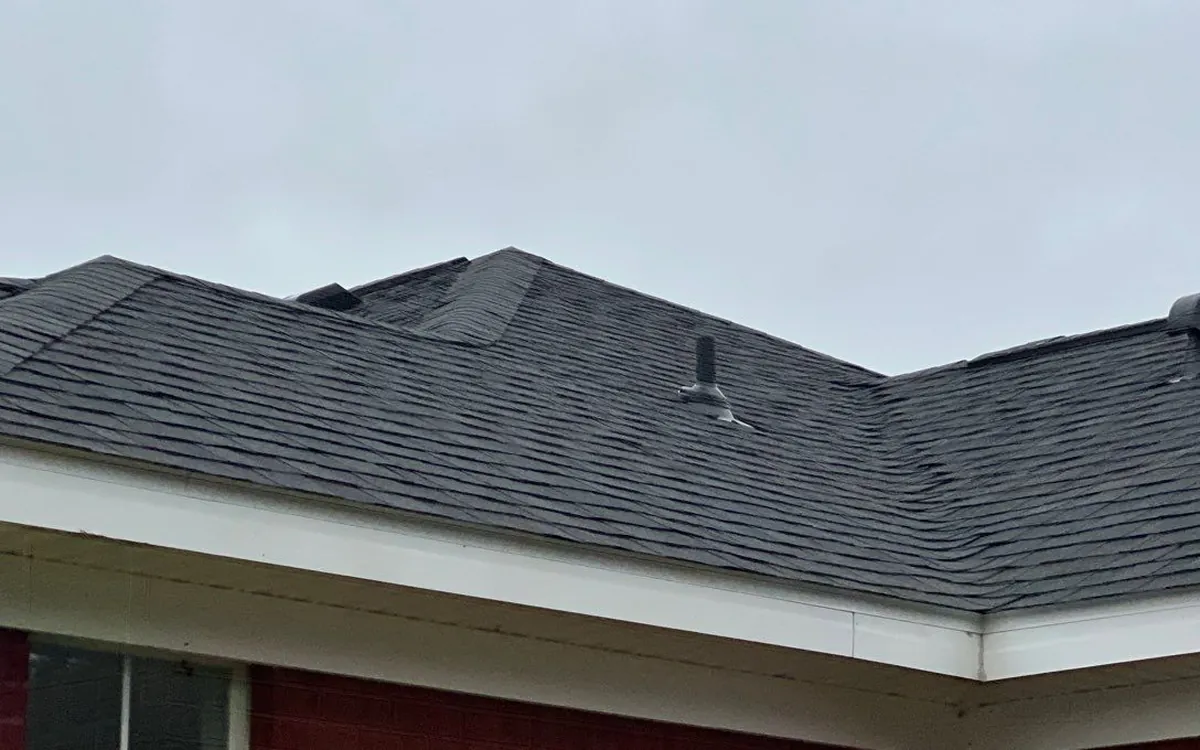
Walk any coastal Alabama neighborhood after a storm and the pattern repeats house to house: the middle of the roof looks untouched and the perimeter is stripped. That is not luck. Wind separating over a building creates its strongest suction at edges and corners, so the eaves, rakes, and ridge are where a roof gets pried open. Everything that happens after — lifted courses, a peeled field, water in the attic — starts at a foot or two of metal most homeowners have never looked at.
What actually happens at the edge
Air moving over a roof does not stop at the wall. It separates at the eave and the rake, and in the zone right behind that separation the pressure drops hard. The roof is not being pushed down in that zone; it is being pulled up.
Two things then decide the outcome. The first is whether the covering's leading edge is locked down — starter course properly oriented and sealed, first courses fastened correctly, edge metal continuous and tight. The second is whether the edge metal itself stays put, because a length of drip edge that peels back becomes a lever handle for the entire perimeter.
Once the perimeter goes, the storm has an opening. Wind gets under the covering and works inward across the field, which is why roofs fail from the outside in rather than in random patches.
Drive through Gulf Shores after any strong blow and the pattern repeats: edge metal first, field shingles second.
Why this coast is a harder case than most
The storm record here is not theoretical. NOAA's HURDAT2 best-track database puts 52 named systems within 100 miles of Mobile Bay since 1950, with 14 reaching hurricane strength near the bay and 27 local landfall points inside that circle. Ivan passed within about 12 miles in 2004, a Category 3 at closest approach. Sally came within roughly 18 miles in 2020 as a Category 2 and crawled, which turned a moderate wind event into an extended one.
Duration is what makes the edge question local. A brief gust tests the edge once. A storm that grinds across Baldwin County and Mobile County for the better part of a day tests it thousands of times, and the failures we see are usually fatigue failures — a fastener working loose, a lap opening slightly, then the whole run letting go. Add salt air along the beach in Gulf Shores and Foley and you have edge metal that may already be corroding at the fastener heads before the storm arrives. The county-level storm counts behind all of this are on the Gulf Coast storm data page with their sources attached.
What a hardened edge looks like
Nothing here is exotic. It is the same components installed to a stricter spec.
- Correctly sized drip edge, with enough leg to actually cover the fascia line and enough flange on the deck to be fastened into structure rather than into the air.
- A tighter fastening schedule along the entire perimeter, not the wide spacing a code-minimum job can get away with inland.
- Proper overlaps at the laps, running in the direction water travels, so a lap cannot catch wind or channel rain backward.
- A starter course that is genuinely a starter course — oriented so its sealant strip is at the eave, sealed down, and not just an upside-down field shingle used to save a bundle.
- Rake and ridge detailing that is rated for the wind zone the house sits in, including the ridge vent, which is a common quiet failure point.
Every one of those is a requirement inside the FORTIFIED Roof standard, and none of them is visible once the roof is finished. That is why the standard demands the work be photographed while it happens and reviewed by an independent, third-party FORTIFIED Evaluator — a separate party you hire, never the roofer who built it. A contractor who offers to both build and certify a roof is describing something the program does not allow.
Is edge work worth it if my roof is otherwise fine?
If the roof is sound and the edge is the weak link, replacing damaged or badly installed drip edge is a legitimate roofing repair and worth doing on its own. Coastal fasteners corrode, sections get dented by debris, and a run that has already lifted once will lift again.
If the roof is near the end of its life anyway, do not spend money twice. The edge, the deck, and the covering all get touched during a re-roof, which is why hardening them together is dramatically cheaper than doing them one at a time. The order to think in is covered in hardening an older coastal roof, and the deck side of the equation is in the sealed roof deck explainer.
Storm season timing matters too. After a named storm, every crew on this coast is booked and every supplier is short, so pre-season work is faster and calmer than post-season work. A pre-hurricane-season roof check covers what to look at and when.
The insurance and funding side, stated plainly
Alabama requires insurers to discount the hurricane portion of a premium by 35–60% and the other-wind portion by 20–35% for a home carrying a FORTIFIED designation (Ala. Code § 27-31D-2.1; Alabama Department of Insurance). Those are percentages of portions of a premium rather than of the whole bill, and the actual figure belongs to your agent, not to a roofer. The mechanics live on the FORTIFIED insurance discount page.
There is also the Strengthen Alabama Homes grant, a state program that pays toward getting a roof built to the standard. Liberty is FORTIFIED-credentialed and is not a Strengthen Alabama Homes program contractor — not on the state's approved-contractor list, and we do not perform grant-funded work. If that funding is your route, the grant page and the standard-versus-program comparison will save you a wasted quarter.
If your edge is already damaged
Lifted or missing edge metal after a storm is not cosmetic; it is an open invitation for the next system. Get it documented before anyone touches it, because photographs taken before the repair are what a claim runs on. Storm damage roof repair covers the sequence, and if water is already coming in, that is an emergency roof repair conversation rather than a planning one.
Common questions
Questions we get about this
Why does wind damage start at the roof edge?
Wind flowing over a building separates at the edges and corners, and the pressure there drops sharply compared to the middle of the roof plane. That suction is strongest at eaves, rakes, ridges, and corners. Once a single shingle or a length of edge metal lifts, wind gets underneath the covering and works inward, peeling the roof from the perimeter toward the center.
What is drip edge and does it really matter in a hurricane?
Drip edge is the metal flashing installed along the eaves and rakes that directs water off the roof and away from the fascia. In a hurricane it does more than shed water — properly sized, correctly overlapped, and fastened on a tight schedule, it locks the perimeter of the covering down. Undersized or loosely nailed edge metal is one of the most common failure points seen after coastal storms.
Can edge metal be upgraded without a full re-roof?
Partially. A damaged or badly installed section of drip edge can be replaced during a repair, and that is worth doing. But the edge metal ties into the starter course and the first courses of the covering, so upgrading the whole perimeter to a hardened standard usually happens during a re-roof when those courses come off anyway.
Do the edge requirements come with the FORTIFIED standard?
Yes. Enhanced edges are one of the core FORTIFIED Roof requirements alongside a sealed deck, an upgraded deck-attachment schedule, and wind-rated coverings and details. The edge work has to be documented while it is being installed, then reviewed by an independent third-party evaluator, because none of it is verifiable once the covering is finished.
Sources
Every non-obvious claim above traces to one of these.
- IBHS — the FORTIFIED Roof standardfortifiedhome.org
- NOAA HURDAT2 Atlantic best-track databasenhc.noaa.gov
- Alabama Department of Insurance — mandated FORTIFIED premium creditsaldoi.gov
Keep reading
 Storm Preparedness
Hardening an Older Coastal Roof, in the Right Order
You cannot harden a Gulf Coast roof piecemeal. What is worth doing now, what has to wait for the re-roof, and what to skip entirely.
 Storm Preparedness
The Sealed Roof Deck, Explained for the Gulf Coast
A sealed roof deck keeps water out after the shingles are gone. What it is, how it is built, and why it is the hardening step to spend on.
 Storm Preparedness
A Pre-Hurricane-Season Roof Check for the Coast
What to check on a coastal Alabama roof before a storm is named, what to photograph now, and why pre-season work beats post-storm work.
Free inspection · no obligation
Want someone to actually look at your roof?
Free inspection anywhere in Baldwin or Mobile County. We climb it, photograph it, and tell you plainly what we found — then put it in writing.
Licensed Alabama roofing contractor #7430. Free estimates across Baldwin and Mobile County.
Loading the quote form…